

In early October, tech media outlet Digitimes (Taiwan, China) published a report stating that large-scale cloud service providers are expanding their partner networks for designing ASIC (Application-Specific Integrated Circuit) chips—chips custom-built for a specific need. According to assessments by industry insiders cited by Digitimes, the era in which a single partner handled an entire ASIC project from start to finish is essentially over. In its place is a co-design model, in which multiple vendors compete to capture a functional part within the same chip architecture.
An entry point for latecomers
Research firm TrendForce forecasts that AI servers using self-developed ASIC chips will account for about 27-28% of AI server shipments in 2026, the highest level since 2023. This figure will rise to nearly 40% by 2030. (This is the proportion by number of servers; by revenue, GPU chips still account for the majority, at around 70% this year.)
Such a direction is already quite clear. Google, Amazon, Microsoft, and Meta are all pursuing their own chips, because a chip matched to their own workloads and infrastructure will be more efficient. When chips become so specific to each customer, no one builds an entire chip on their own anymore.
The Digitimes Intelligence division recently also noted that the hotspot of the AI race is shifting from the chips themselves to the connections between them, across three layers: platform chipmakers holding the switching architecture, active interconnect integrated circuit (IC) vendors, and suppliers of cables, connectors, and optical components.
An increasingly specialized supply chain entails two consequences. First, major customers must coordinate with multiple partners to develop and finalize products. Second, whenever a new standard emerges or technology transitions to the next generation, positions among vendors are somewhat reshuffled, and the market share of early movers is often partially redistributed.
That is precisely the entry point for latecomers: there is no need to win the competition to build an entire chip, but only to win in a specialized technology or stage.
Alphawave Semi is the most recent example. Based in the UK and Canada, this company specializes in high-speed connectivity. The business was acquired by Qualcomm in late 2025 in a deal worth approximately $2.4 billion, aimed at adding connectivity capabilities to its expansion strategy into the data center market.
eMemory in Taiwan (China) took a different and longer path. Founded in 2000, the company develops IP (functional blocks on a chip) for logic-embedded non-volatile memory (OTP, MTP), later adding security IP based on PUF (Physically Unclonable Function) hardware security technology. According to the company's own disclosures, it has provided designs to more than 2,200 chip contract manufacturers (foundries), integrated device manufacturers (IDMs), and semiconductor design companies that do not own fabrication plants (fabless), and has been honored by TSMC in its OIP program for 14 consecutive years. Its revenue comes from license fees tied to customers' wafer volume.
The two businesses pursue different markets: one sells high-speed connectivity for data centers, while the other sells embedded memory and security for all kinds of chips. What they have in common is that each possesses specialized capabilities with clear value that are hard to replace in the supply chain. Of course, these are the teams that have reached the finish line. The teams that started at the same time and stopped midway rarely appear in the news.
What Vietnam has and what it lacks
Vietnam’s biggest advantage is its engineers. The Semiconductor Industry Development Strategy (Decision 1018/QD-TTg) sets a target of having at least 100 design enterprises and more than 50,000 engineers and bachelor's degree holders for the industry by 2030. But assuming there are enough skilled engineers, what turns them into a business capable of selling to foreign customers?
In my view, Vietnam still lacks several important conditions to turn its workforce advantage into business capability in the semiconductor industry.
First is the output market: domestic market demand for advanced SoC chips (chips integrating multiple processing components and functions on a single integrated circuit) remains small, so chip design startups will have to look for customers abroad.
Second is technical proof: customers only trust designs when they see the chip on a real wafer and know its performance, yet every tape-out (finalizing a design to send for trial fabrication) costs money. This part is beginning to have a foundation, with the National Center for Supporting Prototype Production of Semiconductor Chips launched in late June and a trial production cost-sharing mechanism.
Third is ecosystem access: access to PDKs (process design kits of foundries), EDA design tools, IP, and partner lists—things that usually require businesses to have relationships and non-disclosure agreements.
For semiconductor startups, the challenge is not only assembling skilled engineers, but also turning their expertise into capabilities that the business can sustain and commercialize.
As I understand it, an engineering team only creates a competitive advantage when it meets three characteristics: scarcity, meaning not everyone can do it; repeatability, getting better the more it is done; and verifiability, meaning having tape-outs, data, and customers willing to serve as references.
Lacking any one of the above factors, that team, however skilled, remains a fragmented group of contractors.
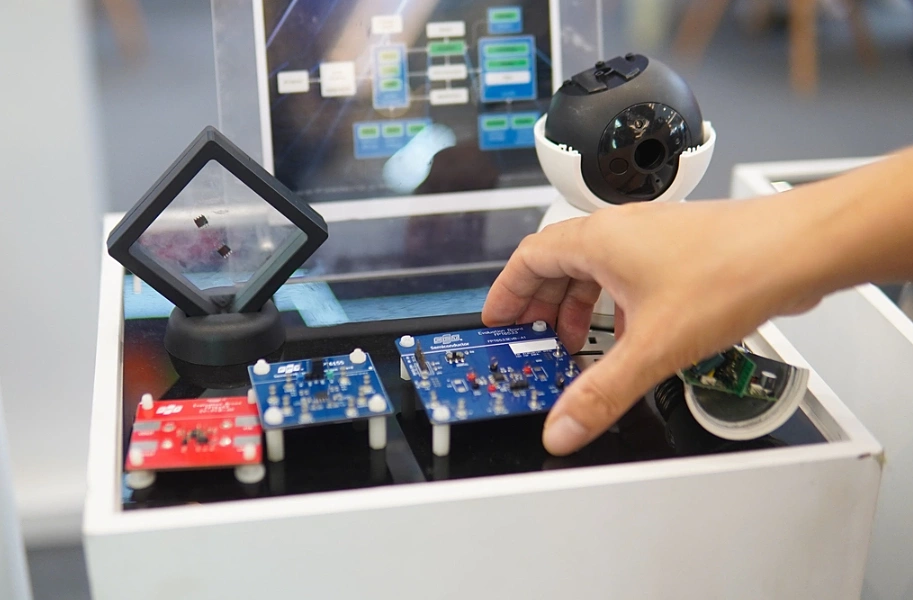
at the SemiExpo Vietnam semiconductor exhibition, November 2025. Photo: Kien Duy - Luu Quy
Four potential directions
From the analysis above, there are four directions for a business to turn its team's technical capabilities into commercial value. These four paths differ in capital, speed to revenue, and durability.
Providing services: The business sells its team's labor across individual stages such as physical design, verification, and design for testability. Capital requirements are low, and credibility is built project by project. This is the fastest money-making path that several young domestic companies are choosing, such as Quy Nhon Semiconductor, established in March 2026, which provides IC design services to international fabless customers. The limitation of services is that revenue scales with headcount, and repetitive work is the part AI compresses first, as I wrote in my article on Kimi K3.
IP design: The business packages a design block to sell multiple times, collecting licensing fees and royalties. Profit margins are typically high, but this requires silicon proof, qualification on foundry processes, and a long sales cycle. Both Alphawave and eMemory belong to this group. Startups can start with mature nodes, which have much lower tape-out costs than advanced nodes.
Platform: The business develops and provides software, automation tools, or data services serving the chip design process (verification, failure analysis, automating final checks before chip printing, AI assistants for using EDA design software). Unlike businesses developing IP or proprietary chips, this direction does not require tape-outs to prove a software product. However, customers are typically chip design companies, which regard design data as a particularly sensitive asset. Therefore, the major barrier lies not only in technology, but also in security capabilities and integrating the software into customers' internal systems.
Building products: The business designs its own chips or chiplets to sell on the market. This is the final and riskiest form because the business must bear the costs of design, manufacturing, packaging, testing, and sales on its own. For new startups, developing a complete chip on their own is usually not the first choice. A business can start by providing design services or developing IP to accumulate experience, understand customer needs, and identify products that have a market before investing in making its own chips.
The four paths above are not rungs on a ladder that a business is required to go through sequentially. However, their order closely resembles the order of risk: the further along, the more capital is needed and the less room there is for error.
From the first few customers to the global supply chain
The first customers usually come from existing relationships: former colleagues at multinational corporations, or foreign fabless startups needing to supplement design capacity at a reasonable cost. A successful project can become a basis for a customer to refer the business to other partners. More importantly, it creates a real-world capability profile, with technical results and successful tape-outs. Only from those initial projects can a business step by step build credibility to be included by foundries, EDA tool vendors, and IP providers in their partner networks.
This process usually takes months, or even years, because there is no shortcut to customer trust. Beyond professional expertise, businesses must also comply with export control regulations, protect customer design data, and follow quality processes. And a position in the chain is never permanent, because every partner has at least one competitor sitting at the same table. Therefore, a business's standing lies not in its current contracts, but in hard-to-replace capabilities: deeply understanding an interface, having multiple tape-outs across multiple nodes (different generations of semiconductor technology), and accumulating enough documentation and tools so that each subsequent execution is more efficient than the last.
Looking at the ongoing shifts in the global semiconductor supply chain, Vietnam's opportunity does not necessarily have to start with developing a complete chip on its own. The more practical issue is identifying the stages that Vietnamese businesses can do well, accumulating sufficient experience, and gradually building proprietary capabilities. That could be the starting point for a startup to participate more deeply in the global supply chain.
(Source: Tia Sang (VnExpress))