
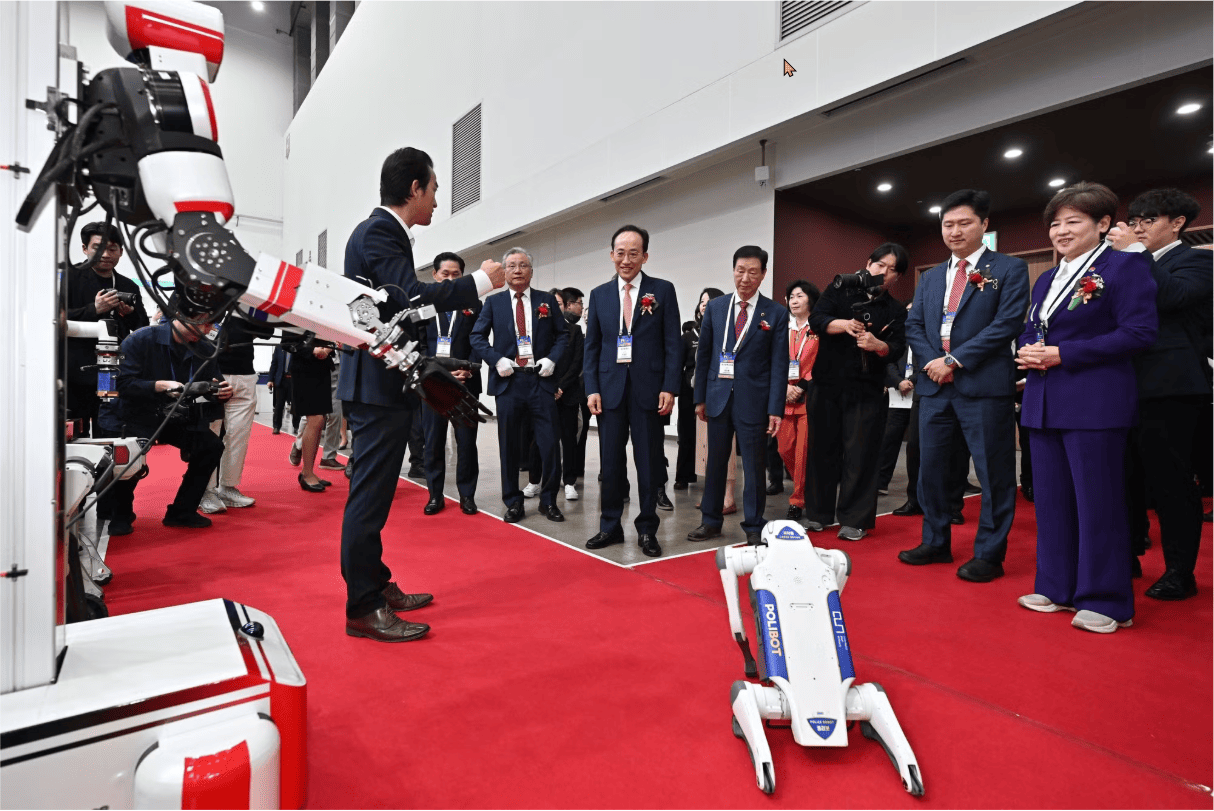
Delegates attending FIX 2026, including Daegu Mayor Choo Kyung-ho, visit exhibition areas
at the Future Innovation Tech Expo (FIX 2026). Photo: AVING News
In late October 2026, the South Korean city of Daegu became a meeting point for the international technology community as the Future Innovation Tech Expo (FIX 2026) concluded after four days. The event attracted 588 companies, approximately 2,000 booths and more than 117,000 visits, showcasing new technologies in artificial intelligence (AI), robotics, next-generation mobility and smart industries.
According to South Korean media, alongside technology demonstrations by major corporations, the presence of local startups was another notable feature of the exhibition. The Daegu Center for Creative Economy and Innovation presented 14 companies selected under the “Startup City” program implemented by South Korea’s Ministry of SMEs and Startups. These companies had opportunities to showcase their products, meet investors and international partners, and seek potential customers. According to the organizers, business-matching activities at FIX 2026 recorded approximately US$353 million in export consulting value and KRW 32 billion in procurement consulting value with domestic conglomerates.
These figures show that the exhibition serves not only as a venue for showcasing technological achievements but also as a channel for connecting businesses with markets. For early-stage startups, opportunities to reach customers, investors and manufacturing partners are no less important than financial support for research.
In fact, efforts to develop Daegu’s technology startup ecosystem have been incorporated into a broader strategy. In May 2026, South Korea’s Ministry of SMEs and Startups announced the “Startup City” development program, which aims to place at least five South Korean cities among the world’s top 100 startup ecosystems by 2030. The program focuses on four localities: Daegu, Gwangju, Daejeon and Ulsan, which are home to major science and technology institutes and have their own industrial and research foundations.
South Korea is not applying a one-size-fits-all model across localities. Daegu aims to develop deep technologies in robotics, mobility, biomedicine, AI and software, building on the foundation of the Daegu Gyeongbuk Institute of Science and Technology (DGIST). Daejeon is leveraging the strengths of the Korea Advanced Institute of Science and Technology (KAIST), together with a network of government research institutes, to develop startups in aerospace, defense, AI, robotics and biotechnology. Gwangju focuses on future mobility, energy, semiconductors and AI, while Ulsan is drawing on its automotive, shipbuilding and petrochemical industries to develop smart manufacturing technologies.
According to South Korea’s Ministry of SMEs and Startups, each locality receives support for talent development, technology commercialization, investment connections and infrastructure development. Science and technology institutes serve as core institutions, connecting with universities, research centers, businesses and investment organizations. The goal is to establish a cycle in which local talent is trained, technology companies are founded and expand their operations locally, and those companies subsequently reinvest in their home ecosystems.
This approach stems from the fact that South Korea’s startup ecosystem has long been concentrated primarily in the Seoul metropolitan area. The concentration of investment capital, highly skilled talent, research facilities and business networks makes it more difficult for startups in other localities to access resources. Rather than simply encouraging businesses to leave Seoul for other cities, the South Korean government aims to create the conditions for businesses to emerge, grow and find business opportunities in their own localities.
Beyond Funding, Startups Need Connections to Markets
One specific feature of the Startup City program is its mechanism for supporting businesses at different stages of development. In Daegu, 74 companies were selected to participate in the program in 2026. The startups receive financial support for product development, technology refinement, talent recruitment, investment connections and market expansion. Maximum support amounts reach KRW 400 million for companies in emerging technology fields and KRW 250 million for those in general manufacturing and technology.
Businesses relocating to Daegu from other localities may also receive rental assistance for up to six months, while being connected with universities, research institutes and startup support organizations in the city. This approach shows that the policy aims not only to establish new businesses but also to attract and retain companies with growth potential.
However, funding or infrastructure alone is not enough to build a startup ecosystem. A startup may have strong technology but still struggle to grow if it cannot find customers, secure businesses willing to test its products or attract investors to support it during commercialization.
Vietnam Needs Ecosystems Built Around Each Locality’s Strengths
In Vietnam, the need to develop local innovation ecosystems is emerging alongside the implementation of Resolution No. 57-NQ/TW on breakthroughs in national development of science and technology, innovation and digital transformation. In this context, bringing research, technology applications and startup activities closer to businesses and residents in localities is important, particularly given the differences in development needs and advantages across regions.
One recent development was the launch of Nghe An Province’s Innovation Center on October 20, 2026, at Vinh University, as part of the opening of Techfest Nghe An Open 2026. The center is intended to serve as a hub connecting government agencies, universities, research institutes, businesses, experts and investors, while helping early-stage projects access technology, capital and market opportunities.
At the event, Thai Van Thanh, Vice Chairman of the Nghe An Provincial People’s Committee, emphasized that science and technology, innovation and digital transformation are important drivers of productivity growth, improved growth quality and the creation of new economic value. He also called for the center’s performance to be assessed against concrete outcomes, such as the number of projects supported, technologies transferred, startups established, investment capital attracted and products commercialized.
Drawing on Daegu’s experience, Vietnam can take away three lessons: each locality needs to select technology fields based on its own strengths; startup support should shift from isolated assistance toward accompanying businesses from research and testing through to product commercialization; and connections with universities, businesses, investment funds, and domestic and international markets should be strengthened.
Resolution No. 57 sets out the requirement for science and technology and innovation to become drivers of development. To turn this goal into reality, localities do not necessarily need to become major technology hubs, but they do need to create an environment where ideas can develop into products, research results can be translated into production, and technology companies have opportunities to grow where they are established.
(According to News and Ethnic Groups – Vietnam News Agency (VNA))