


According to The Conversation, California-based startup Reflect Orbital plans to place giant mirrors in low Earth orbit to redirect reflected sunlight towards selected locations on the ground. The company aims to sell space-based lighting services for a range of purposes, from keeping solar farms operational after dark to supporting search and rescue operations. Its first test device, the Eärendil-1 satellite, is scheduled for launch next year and will carry an 18 x 18-metre reflective mirror.
The idea of using mirrors in space to provide useful illumination faces significant technical challenges. Reflect Orbital says its mirrors can illuminate customers’ solar farms or specific rescue sites without affecting surrounding areas. However, the reality is far more complicated, as Earth’s atmosphere will scatter the light rather than confine it within clearly defined boundaries.
A scientific study published last August in IOP Science simulated how reflected sunlight travels through the atmosphere, showing that molecules and aerosols scatter part of the radiation beam across the sky. When the light reaches the ground, it is reflected back upwards and continues to scatter, causing its effects to extend over a much wider area than intended.
For the 54-metre mirror Reflect Orbital plans to use, the illuminated area could extend considerably beyond the intended target. At a location 14 km away from the beam, the sky would still be brighter than on a night with a full moon. Even at a distance of 34 km, looking towards the beam, the sky would still appear brighter than under a full moon.
Although these are model-based predictions rather than measurements taken from an actual mirror in space, the findings highlight the potential impact of the company’s service on a large number of people. Reflected light could affect natural darkness across a much wider area than customers request.
According to The Guardian, on October 10, Reflect Orbital placed powerful mobile floodlights on the ground near the town of Lone Pine and the Mount Whitney area in California’s Sierra Nevada region to simulate illumination from future satellite-mounted mirrors. However, some local residents described the beams as “blinding”.
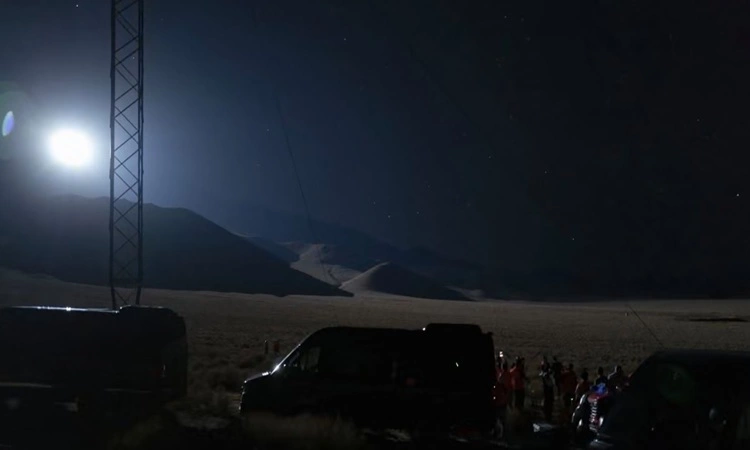
the United States. Photo: Reflect Orbital
In July, the US Federal Communications Commission (FCC) authorized Reflect Orbital to deploy and operate Eärendil-1. However, the authorization only covers radio communications, specifically the use of certain frequencies to control and monitor the satellite.
In August, four organizations represented by Earthjustice asked the FCC to reconsider its approval, citing concerns that reflective satellites could cause a range of problems. Animals such as birds, insects and mammals rely on the regular alternation between day and night to find food, seek shelter and reproduce. Any disruption to this cycle could have severe consequences for them. Similarly, changes to the day-night cycle could harm human health by disrupting circadian rhythms.
Meanwhile, astronomers have complained that nighttime illumination would worsen existing light pollution, obscure stars and increase the amount of space debris falling back to Earth. They called on the FCC to introduce safeguards to minimize unintended optical impacts. However, the agency declined, stating that astronomy falls outside its regulatory remit.
Reflect Orbital’s agreement with India’s Skyroot Aerospace includes two separate launches using the Vikram-1 and Vikram-1U rockets, which are currently under development. Each launch from India requires approval from the Indian National Space Promotion and Authorization Center (IN-SPACe), based on safety, registration and environmental impact requirements. The agency generally requires measures to limit adverse environmental impacts, whether on Earth or in space, as well as harmful changes to the atmosphere. This means India could face an issue that the FCC has avoided addressing. It remains unclear how IN-SPACe will handle intentional reflected sunlight.
Although Reflect Orbital is a US company, the Skyroot rockets and launch site are based in India. The Eärendil-1 satellite could illuminate the territory of a third country. Atmospheric scattering means its effects could extend far beyond the intended target. One question that needs to be addressed is whether commercial operators seeking to illuminate a location in another country would also need authorization from the relevant authorities in that country.
However, Eärendil-1 could provide regulators with real-world data on brightness levels, atmospheric scattering and the ability to control reflected light. Reflect Orbital says it will continue working with astronomers, local communities and regulators as it expands its testing program.
(Source: VnExpress)